
The factory: how Maleus builds software
Not a tool: a production line
Maleus is a factory: a chain where every station is held by a specialized agent-operator. A business need goes in one end; deployed, operated software comes out the other.
Need
Plain-language brief
Workshop
Scoped into versions
Design
Working interfaces
Specs
Stories, API, data model
Build
Back + front + tests
QA
Automated validation
Deploy
Pipeline to running
Operate
Monitored & maintained
Need
Plain-language brief
Workshop
Scoped into versions
Design
Working interfaces
Specs
Stories, API, data model
Build
Back + front + tests
QA
Automated validation
Deploy
Pipeline to running
Operate
Monitored & maintained
From idea to running software, step by step
Every stage of the Maleus cycle, framed by what it gives you. The mechanics matter, but the outcome is what you should remember.
Project
You frame what you want to build in plain language. No template to fill, no spec document to write first: the conversation is the starting point.
Workshop
The agent understands your need and breaks it down into deliverable versions: an agile, sprint-style plan you can actually ship against.
Design
2-3 min / iterationYou get working, testable interfaces, not dead mockups. Every iteration is something you can click through and react to.
Specs
User stories, API contracts and the data model are generated alongside the app: the documentation is never out of date because it is the build.
Build
45-60 min / versionBackend, frontend and tests, with agents coding in parallel. A complete, working version of the application, not a snippet.
QA
Automated validation runs continuously, with human checkpoints where they matter. Quality is checked as the software is built, not bolted on after.
Deployment
10-15 minAn automated pipeline takes the application all the way to running, infrastructure included, with a human sign-off before anything goes live.
One specialized agent per craft
Each station of the cycle is held by an agent-operator built for that job. Any profile can put the whole team to work, without being an expert in every craft.
Product Manager
Turns a need into epics and deliverable versions, and keeps the build aligned with the outcome you asked for.
Designer
Iterates on the interface and applies your design system: working screens, not static comps.
Business Analyst
Writes the technical-functional specs: user stories, API contracts and the data model.
Software Engineer
Builds the backend and frontend, writes tests, and debugs autonomously until the version works.
QA
Runs automated tests and validation, surfacing issues before they reach a human reviewer.
Cloud Engineer / SRE
Handles operations: dashboards, monitoring and incident agents that keep applications healthy.
Agents work in parallel. Backend and frontend are built side by side, the way a real engineering team operates.
Drop in raw context. Get a buildable plan.
A workshop takes a raw business need (a document, a scoping-meeting transcript, a real spreadsheet) and turns it into deliverable versions, with an interface you can already click through and test.
Hand it the transcript of a scoping call and it returns an agile version plan plus a working interface. Hand it a client's actual Excel file and it extracts the business rules on its own, then generates the application around them.
Input
Deliverable versions
New builds and existing systems alike
Lost specs, unmaintained documentation, hard-to-touch legacy: a near-universal pain. Maleus does not only start from zero; it takes the existing system back in hand.
Build a new application
Start from a blank page. Describe the product you want and the factory takes it from need to deployed software.
- No existing codebase required
- Full cycle from the first conversation
- Production-grade from version one
Take over what already exists
Import an existing project. Maleus reverse-engineers the specifications, generates end-to-end tests, and modernizes the application, for instance a legacy WordPress site weighed down by plugins.
- Automatic reverse-engineering of specs
- End-to-end tests generated for safety
- Modernization without a rewrite from scratch
“Make this section collapsible and move the total to the top.”
Comment in plain language. It gets fixed.
Click an element, write what you want changed in plain language, and the agent applies the fix, typically in around ten minutes. No ticket, no translation into technical requirements.
Embeddable. The widget drops into an existing application, not only ones built by Maleus.
Built-in support. It ships with a level-one support chatbot grounded in the application's own specs.
The factory does not stop at the code
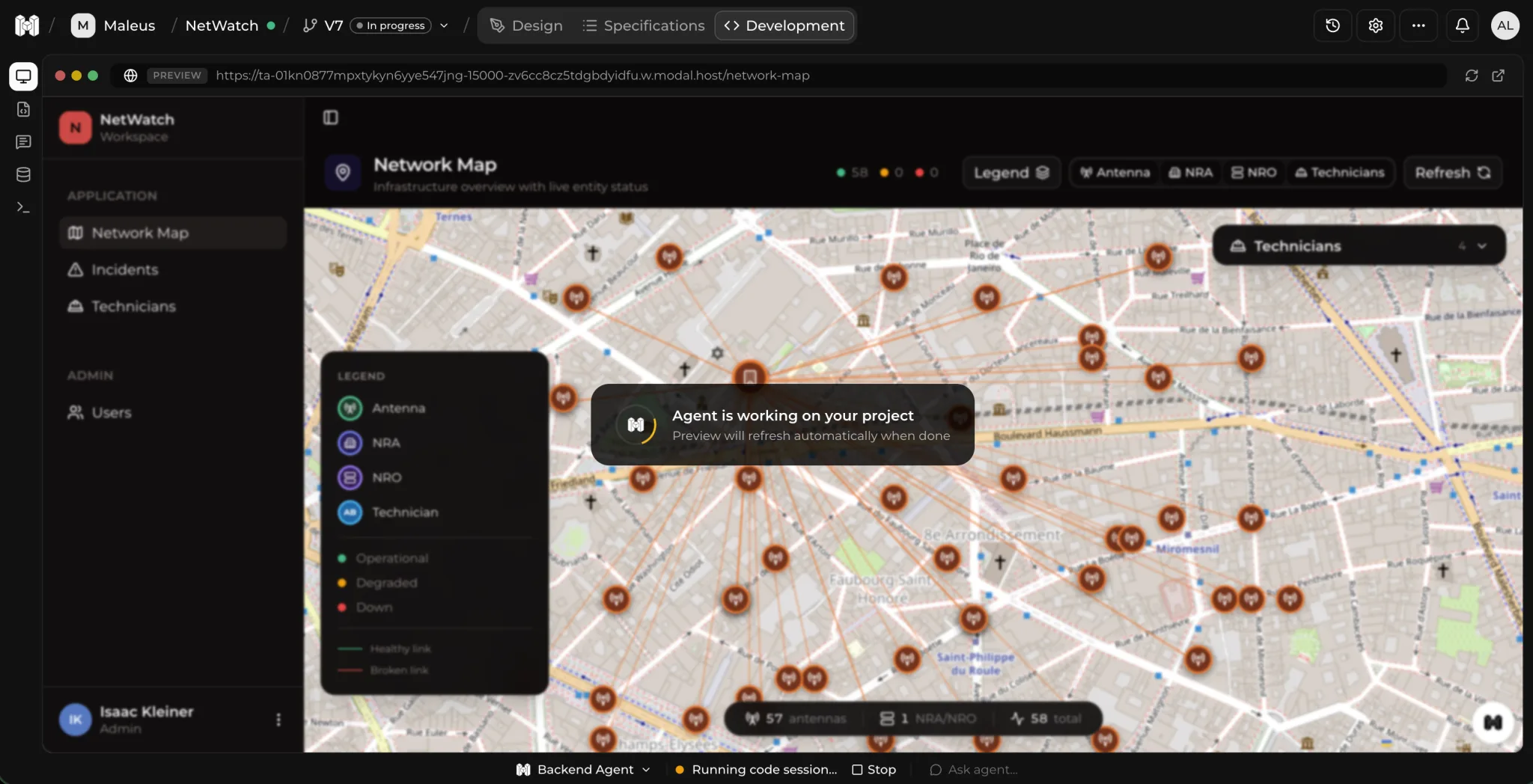
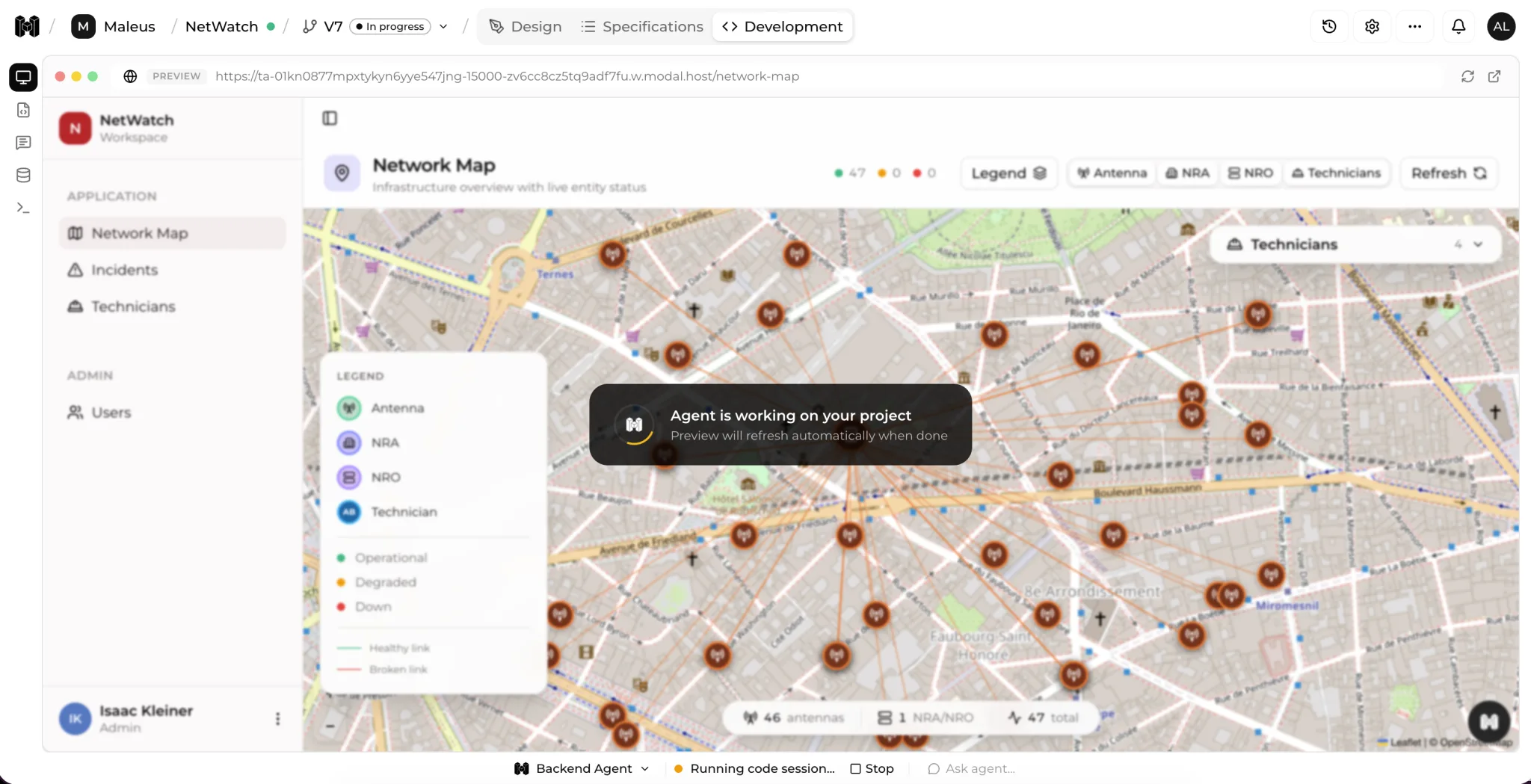
It deploys and operates. Applications reach a running state, stay monitored, and recover from incidents, with a human in the loop where it counts.
Deployment
An automated pipeline takes each application all the way to running, in 10 to 15 minutes.
Monitoring
A per-application dashboard: alerts with automatic incident reports, correlated logs, and downtime and SLA metrics.
Automatic repair
Operations agents investigate and triage incidents: alert to report to a one-click fix.
A human sign-off is required before any infrastructure deployment. Incidents are categorized and escalated, never silently actioned. See how this is enforced on the security page.
See the factory in action
The fastest way to understand how Maleus builds software is to watch it happen: from a plain-language need to deployed, operated software.